


Summary
Architects no longer need to compromise between natural timber aesthetics and structural permanence. This guide explores how premium biosourced composite products and advanced exterior systems mitigate the risks of UV degradation and moisture, offering developers predictable, low-maintenance lifecycle savings.
The organic warmth of timber remains one of the most powerful tools in contemporary architecture. Whether softening a minimalist residential volume or adding tactile texture to a commercial podium, wood connects the built environment to the natural world. However, the gap between architectural vision and material reality often widens rapidly after handover.
Key Takeaways:
- Premium biosourced composite materials eliminate the organic wood fibers responsible for warping, rotting, and moisture absorption in traditional timber exteriors.
- The utilization of core color-matching ensures that heavy high-traffic abuse or surface scratches remain virtually invisible across commercial flooring and decking surfaces.
- Verifiable environmental credentials, including comprehensive EPDs, allow specifiers to meet strict LEED and BREEAM standards while actively avoiding industry greenwashing.
Natural wood is inherently volatile. Exposed to shifting climates, it suffers from UV degradation, moisture absorption, warping, and splintering. For specifiers, this translates to a compounding lifecycle cost of annual sanding, staining, and sealing, or worse, premature structural failure.
To preserve design integrity without burdening developers with perpetual maintenance, a shift in material specification is required. Novano’s biosourced composite technology bridges this gap, decoupling the timeless aesthetic of raw timber from its traditional structural liabilities.
Decoupling Aesthetics from Maintenance: The Rise of Advanced Composites
For decades, specifying low-maintenance exterior building products meant accepting a visual compromise. Early-generation Wood-Plastic Composites (WPCs) often featured a highly uniform, artificial sheen that lacked the depth and organic variance of natural timber. Furthermore, their high plastic content led to significant thermal expansion and contraction, challenging the crisp, clean lines required by modern design.
Material science has evolved past these early iterations. Today, high-performance, low-maintenance exterior solutions rely on 100% wood-free, enhanced fiber composites. By eliminating organic wood fibers from the core matrix entirely, these advanced composite materials remove the cellular pathways that allow moisture to penetrate, freeze, and rot the board from within.
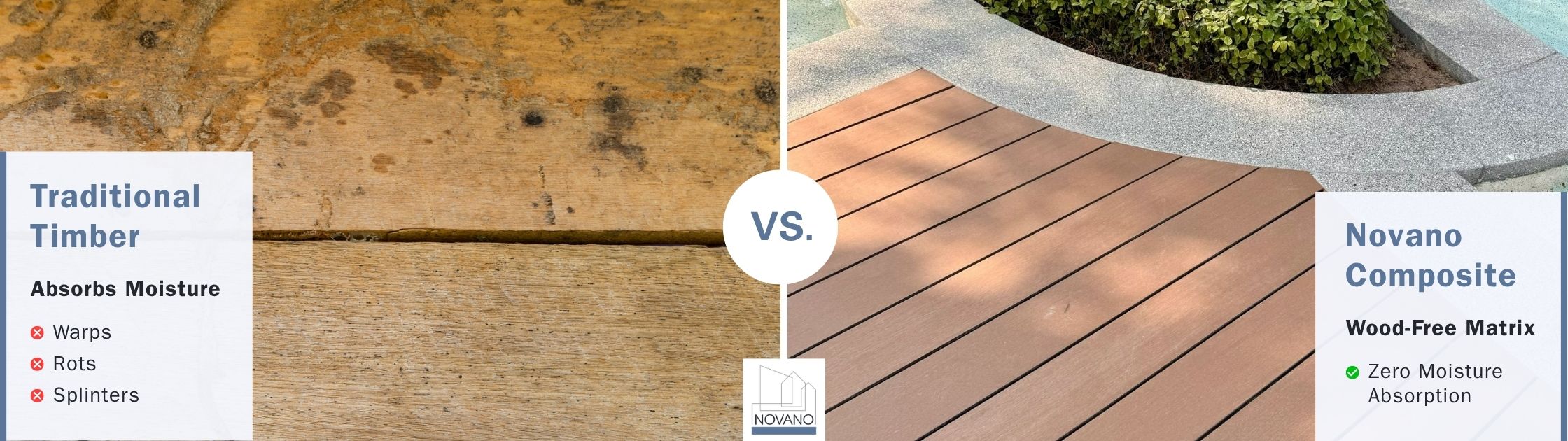
Surface engineering further elevates these systems. Novano’s advanced coating system, featuring ArmorTone™ technology and Novano with PPG technology, applies a protective topcoat that chemically blocks UV radiation. This molecular barrier prevents the severe silvering and fading typical of natural species like cedar or larch, ensuring the building looks exactly as intended for decades to come, without a single drop of stain.
What to Look For: Premium “Timber Look” Products for Architects
Premium Decking & Commercial Flooring

Commercial and high-traffic residential surfaces demand excellent wear resistance. Traditional timber decking quickly shows traffic lanes, scratches, and heel gouges. Advanced composite decking solves this through deeply embossed, highly durable outer shells. Crucially, Novano utilizes a core color-matching system. If a heavy object is dragged across the surface, the core color matches the outer shell exactly, rendering minor abrasions virtually invisible.
High-Performance Siding & Wall Cladding
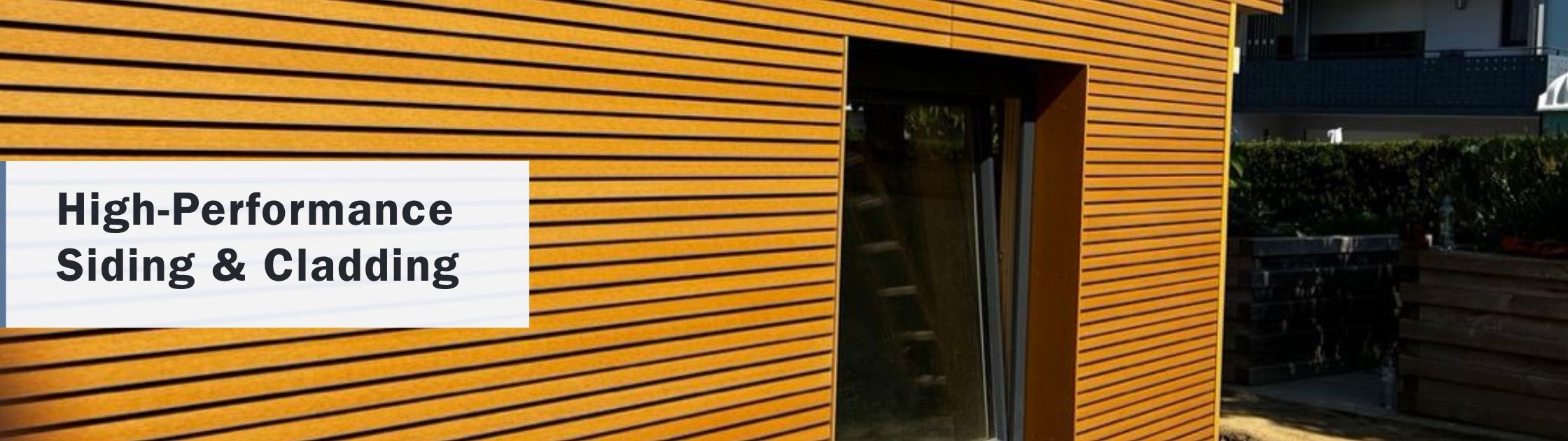
Achieving a seamless shadow-line or a precise open-joint aesthetic requires cladding profiles that will not cup or bow over long spans. Advanced composite siding offers excellent structural integrity, enabling clean, continuous lines across large vertical surfaces. Because the material does not expand or contract drastically with temperature swings, architects can specify tight joints and complex geometries with total confidence.
| Performance Metric | Novano Enhanced Fiber Composite | Traditional Exterior Timber |
| Annual Maintenance | Simple wash with water | Sanding, staining, oiling required |
| Moisture Resistance | <1% absorption; impervious to rot | High absorption; prone to rot |
| Color Stability | UV-blocked; minimal color shifting | Rapid UV silvering and fading |
| Dimensional Stability | Exceptionally stable; no warping | Warps, twists, and splits over time |
Specifying with Confidence: Mitigating Risk via Long-Term Warranties
Every specification carries an element of professional risk. Architects and developers face real liability and reputational damage if an exterior product degrades prematurely or fails to meet local building codes. When a decking or facade fades unevenly or begins to delaminate, it reflects poorly on the design firm’s material intelligence.
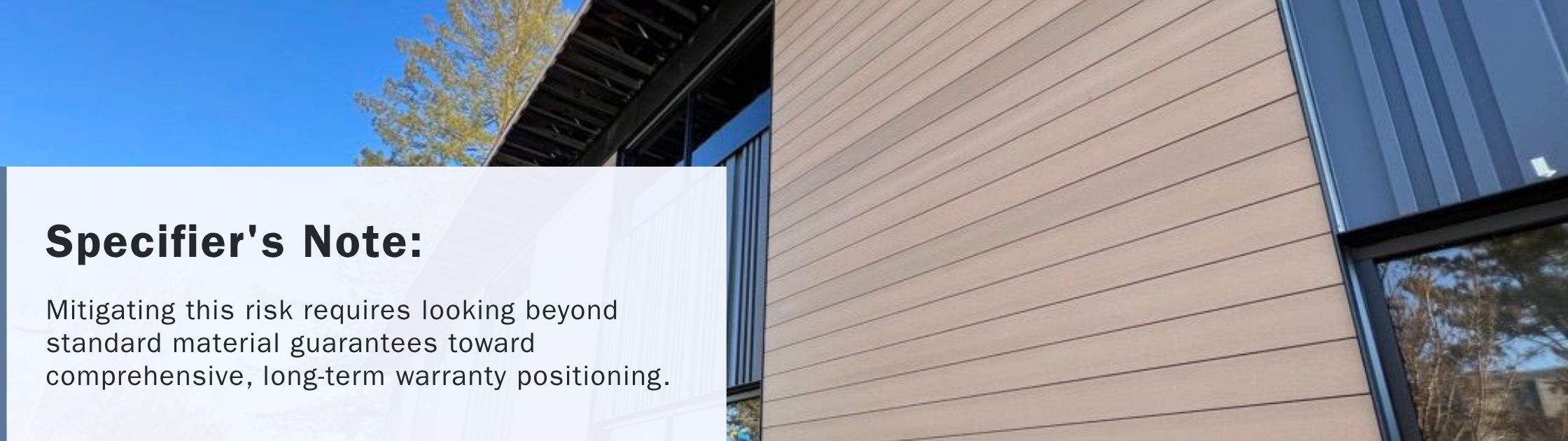
A robust manufacturer’s warranty transforms the exterior from a volatile maintenance liability into a predictable financial asset. For developers, the value proposition is clear: higher upfront material quality yields lower operational expenses. By eliminating the need for recurring scaffolding, labor, and chemical coatings every two to three years, the total cost of ownership of premium composite products drops significantly below that of natural wood within the first decade of a building’s lifecycle.
True Sustainability: Beyond the Greenwashing
In an era where sustainability claims are frequently diluted by vague buzzwords, specifiers must demand verifiable data. Calling a material “eco-friendly” is no longer sufficient; true environmental stewardship must be backed by Environmental Product Declarations (EPDs) and clear contributions to green building rating systems like LEED or BREEAM.
Novano’s biosourced formula targets sustainability at the molecular level. By utilizing 100% wood-free, bio-based waste streams and recycled polymers, these composite materials avoid harvesting living forests. This circular manufacturing process actively diverts waste from landfills while creating a highly durable, long-lasting building component that does not leach toxic chemicals or sealants into the surrounding ecosystem during its service life.
The New Standard for Exterior Architecture
The historical dichotomy between the authentic beauty of natural timber and the rugged resilience of synthetic materials is obsolete. Advanced material engineering allows contemporary architecture to achieve both simultaneously. By specifying high-performance, biosourced composite solutions, designers protect their visual intent, developers secure their assets, and the built environment gains a durable, truly sustainable envelope.
To experience the tactile quality and color depth of these advanced profiles firsthand, contact Novano’s in-house architectural support team today to request a curated product sample kit or discuss custom manufacturing specifications for your next project.

FAQs
How do biosourced composite materials compare to traditional wood-plastic composites (WPCs)?
Traditional WPCs rely on organic wood flour that can still absorb moisture and promote mold growth over time. Novano’s biosourced composites utilize a 100% wood-free, bio-based matrix that completely eliminates these failure points while offering superior dimensional stability.
Can these low-maintenance cladding systems handle extreme temperature fluctuations without warping?
Yes, these engineered profiles are specifically designed with low thermal expansion coefficients to ensure high dimensional stability. They resist cupping, twisting, and bowing even when exposed to severe freeze-thaw cycles and direct, intense sunlight.
What kind of maintenance is required to keep composite siding looking pristine?
Unlike natural wood which requires biennial staining or oiling, premium composite products require no specialized chemical treatments. A periodic wash with mild soap and water is all that is needed to maintain the original color and texture.
How do these alternative timber products contribute to LEED certification?
Novano products contribute to LEED points by utilizing recycled content, bio-based waste streams, and avoiding the VOC emissions associated with traditional timber sealants. Third-party testing documentation and material ingredient optimization reports are available to streamline the specification process.